In cross-section
How they are built
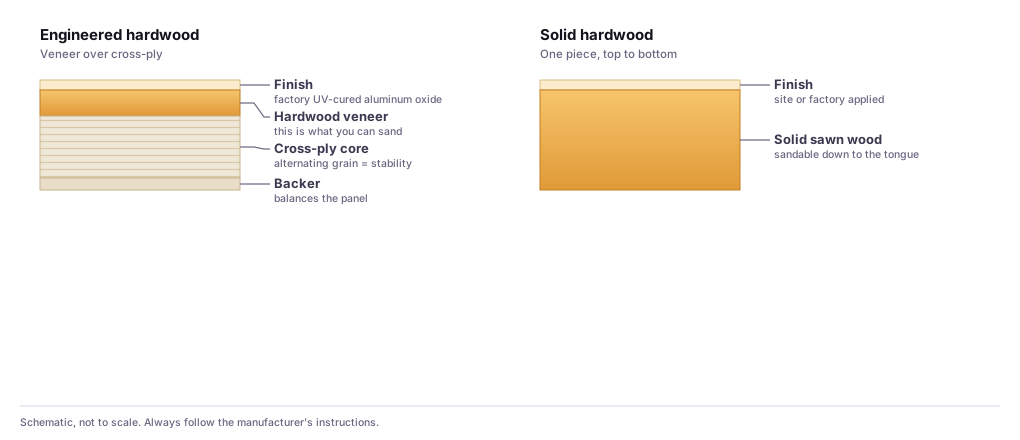
Both are real wood on the surface. Solid gives you the most refinishes and the longest life, but only over a wood subfloor above grade. Engineered goes where solid cannot — over concrete, below grade, over radiant heat — and a thick-veneer engineered board is not a compromise product.
Installed cost includes material and professional labor. Ratings are relative across all 18 materials on this site, not absolute scores.
| Solid Hardwood | Engineered Hardwood | |
|---|---|---|
| Installed cost per sq ft | $9.00–$22.00 | $7.00–$19.00 |
| Expected service life | 50–100 years | 20–50 years |
| Cost per sq ft per year | $0.21 | $0.37 |
| Durability | 4/5 | 4/5 |
| Water resistance | 1/5 | 2/5 |
| Comfort underfoot | 3/5 | 3/5 |
| Sound absorption | 2/5 | 3/5 |
| Ease of maintenance | 3/5 | 3/5 |
| DIY friendliness | 1/5 | 3/5 |
| Environmental profile | 4/5 | 4/5 |
| Traffic rating | Heavy | Heavy |
| Commercially rated | Yes | Yes |
The points that decide this in practice — not the spec sheet items that read well but rarely change anyone's mind.
Solid hardwood is typically 3/4 inch with roughly 1/4 inch of usable wood above the tongue — that is several sandings across a very long life. Engineered has a veneer over plywood or HDF, and the veneer is what you can sand. Under 2mm is effectively a one-time light screen at best. At 3mm you get a refinish or two. At 4 to 6mm you are in the same practical territory as solid for most households. Ask for the veneer thickness in millimeters and treat any answer that dodges the question as a red flag.
The cross-ply construction resists cupping and gapping when humidity swings, which is why it works over slabs and radiant heat. But the surface is the same wood as solid — it dents and scratches identically, because a white oak veneer and a white oak plank are the same material where your shoes meet it. People conflate stability with toughness; they are separate properties.
This is a moisture rule, not a style rule. Below-grade concrete carries vapor drive from the soil, and solid wood installed over it will cup, crown or buckle. Engineered over a proper moisture barrier is the correct specification. Test the slab before either product goes down — ASTM F2170 in-situ relative humidity is the test that matters, and skipping it is the most expensive shortcut in the trade.
Premium engineered with a thick veneer often costs more than mid-grade solid. Cheap engineered with a paper-thin veneer is inexpensive for a reason and should be compared against laminate or LVP, not against solid hardwood. The category name tells you very little about quality; the veneer spec tells you nearly everything.
$9.00–$22.00 per sq ft installed, lasting 50–100 years — about $0.21 per sq ft per year.
Wide planks (6"+) look current but move more seasonally. In a dry climate, expect visible winter gaps unless you humidify.
$7.00–$19.00 per sq ft installed, lasting 20–50 years — about $0.37 per sq ft per year.
Ignore the price tag and read the wear-layer spec. Two floors at the same price can differ by 25 years of service life.
Yes. The wear surface is a genuine hardwood veneer, so it looks and behaves like wood underfoot. What differs is the construction beneath — cross-layered plywood or HDF instead of a solid sawn plank — which makes it more dimensionally stable and suitable over concrete and radiant heat.
It depends entirely on the veneer thickness. Under 2mm, treat it as not refinishable beyond a light screen and recoat. Around 3mm, expect one or two refinishes. At 4 to 6mm, several — comparable to solid for most homeowners. Always ask for the number in millimeters rather than accepting "refinishable" as an answer.
Not as a normal practice. Solid wood over a slab risks cupping and buckling from vapor drive, particularly below grade. Engineered over a tested slab with an appropriate moisture barrier is the correct approach. If solid is non-negotiable, it requires a built-up plywood subfloor system, which adds height and cost.
Engineered hardwood is real wood that can be refinished and adds resale value. LVP is waterproof, cheaper and more…
Hardwood is a multi-decade floor that can be refinished and adds resale value. Laminate is a wear-layer product at a…
Engineered hardwood is real wood that may be refinishable and adds resale value. Laminate is a photograph under a very…