Luxury Vinyl Plank — SPC (Rigid Core)
Stone-composite core: 100% waterproof and dimensionally rock-steady.
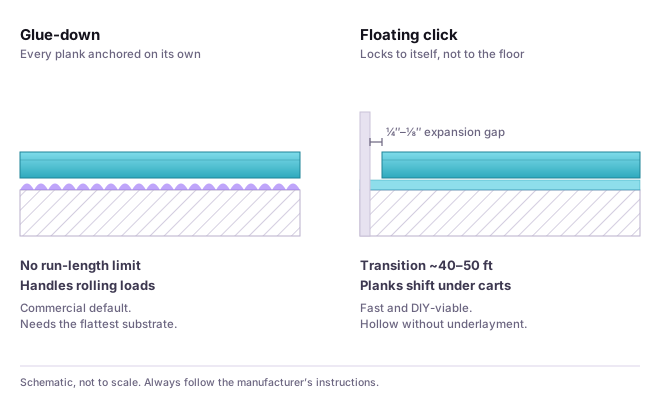
Floating is faster, cheaper and DIY-viable, and it is the right answer for most residential rooms. Glue-down is quieter, more solid underfoot, handles rolling loads and large open runs without transitions, and is effectively mandatory in commercial work. The size of the area and what rolls across it decide this more than anything else.
| Glue-down | Floating click | |
|---|---|---|
| Typical use | Commercial, large open plans, rolling loads | Residential rooms of ordinary size |
| Continuous run limit | Effectively none | Often around 40–50 ft before a transition is required |
| Subfloor flatness | Strictest — telegraphs directly | Strict — deflection opens joints |
| Sound underfoot | Solid and quiet | Hollow without good underlayment |
| Rolling loads | Handles them | Planks shift and joints separate |
| Slab moisture tolerance | Lower — adhesive bond is the weak point | Higher over a vapor retarder |
| Installation speed | Slower, plus adhesive cure time | Fast, no cure |
| DIY viability | Professional work | Realistic for a careful DIYer |
| Removability | Permanent, destructive to remove | Lifts back out |
| Installed cost | Higher — labor and prep | Lower |
The factors that change the outcome on a real job, in rough order of how often they turn out to be the deciding one.
A floating floor is one connected raft that expands and contracts as a unit, so manufacturers cap how far it can run before it needs a break. Many put that limit somewhere around 40 to 50 feet in a given direction, at which point you need a T-molding to split the floor into independent sections. In an open plan that means a metal strip across the middle of a room nobody wants a strip in. Glue-down has no such limit — every plank is anchored independently, so it runs wall to wall through the whole house. If your layout is long or open, this alone can settle the decision. The exact figure varies by product, so read the specific installation instructions rather than assuming a number.
Glue-down conforms to whatever is underneath it, so dips and ridges telegraph straight through to the surface where you see them in raking light. Floating bridges small irregularities visually, but the plank then flexes over the void every time somebody walks across it, and that repeated deflection is what works click joints apart. So one shows you the problem and the other hides it until the seams open. The common target for plank is flatness within about 3/16 inch over 10 feet, tightened toward 1/8 inch for glue-down where appearance matters. Grinding and patching before installation is not optional preparation you can economize on.
A floating floor is suspended over a pad, so footsteps drum. Attached IXPE or cork underlayment dampens it meaningfully and is worth having, but it does not make a floating floor sound like a glued one. Glue-down is bonded to the substrate with no air gap, so it is solid and quiet — noticeably so in an empty room or a hallway. If sound transmission to a room below matters, look at the tested IIC rating for the whole assembly rather than assuming the pad handles it.
Office chairs, hand trucks, wheelchairs, hospital beds and rolling toolboxes all push a floating floor sideways. Over time the planks shift, gaps open at the ends and joints unlock. Glue-down resists that because the adhesive holds every plank in place. This is why commercial specification defaults to glue-down almost without discussion, and it applies at home too — a home office with a rolling chair on a floating floor is a known problem.
Adhesive is the vulnerable component. Vapor driving up through a slab breaks the bond and the floor releases, which usually presents as loose or shifting planks and looks like installer error when it is a moisture problem. Test to ASTM F2170 in-situ relative humidity — the general limit is 75% unless the manufacturer allows higher, and some pressure-sensitive adhesives are rated well above that. Floating over a vapor retarder is more forgiving because nothing is bonded to the slab. On a basement floor with any moisture history, this is a genuine argument for floating.
Damage a plank in a floating floor and you can unclick from the nearest wall to reach it, or cut it out and drop in a replacement with the locking edges trimmed. Damage a glued plank and you heat it, pry it out, scrape the old adhesive and set a new one — messier, but it does not disturb anything around it. Neither is difficult for a competent installer. What matters more is keeping attic stock, because color runs shift and the plank you need in year five will not match a fresh order.
The planks cost the same. Glue-down adds adhesive, adds trowel work, adds cure time before you can move furniture back, and it demands the flatter substrate discussed above — so prep costs rise too. Floating goes down quickly with no cure, which is exactly why it dominates residential retail. Expect glue-down to run meaningfully higher installed, and treat any bid where the two are priced the same as a bid worth questioning.
Glue-down has almost no build-up beyond the plank itself. Floating adds the pad, and if the product has attached underlayment you are stacking that too. In a kitchen where the dishwasher has to slide out from under a countertop, or at a doorway meeting an existing floor, a few millimeters decides whether the job is clean or involves undercutting. Measure the finished height before ordering, not after.
Installation method is not an LVP-only question. What changes is which methods are available at all.
All three methods are on the table, and that is the point people miss. Nail or staple down over a wood subfloor is the traditional route and feels the most solid. Glue-down is the standard specification over concrete, where nailing is not an option, and it gives the quietest result. Floating click engineered exists and installs fast, but it is the least common in premium product and is the most likely to sound hollow. Over a slab, glue-down is usually the right answer; over plywood above grade, nail-down.
Effectively always floating. Laminate is engineered as a click-together raft over a pad, and glue-down laminate is largely obsolete. That means every floating consideration on this page applies with full force — run-length limits, expansion gaps at every wall, hollow sound, and strict flatness. If you need a glued floor in that price range, look at glue-down LVP instead.
Nail or staple down over a wood subfloor is the normal method, and it is why solid feels solid — it is mechanically fastened to the structure. Glue-down solid is done, mainly over slabs with a suitable adhesive and moisture system, but it is demanding work. Solid hardwood is never floated. If you are being offered a floating solid floor, something is being described incorrectly.
Neither is better everywhere. Floating is faster, cheaper and fine for normal residential rooms. Glue-down is quieter and more solid, handles rolling loads, and runs unlimited distances without transition strips, which is why commercial work specifies it almost universally. Decide on the size of the area, what rolls across it, and whether the slab has moisture history.
Because it is suspended over a pad rather than bonded to the subfloor, so there is an air gap that drums under footsteps. Quality attached underlayment reduces it considerably but does not eliminate it. Hollow spots in specific areas usually indicate the subfloor is not flat there, and that deflection will eventually work the click joints apart.
Usually yes, beyond a certain run length — many manufacturers require a break somewhere around 40 to 50 feet in a given direction so the floor can expand and contract in independent sections. The exact limit is product-specific and stated in the installation instructions. Glue-down has no equivalent restriction, which is a major reason it is chosen for large open plans.
Sometimes, but only if the manufacturer explicitly permits it — many do not, and doing it anyway typically voids the warranty. Click products are engineered to move as a raft, and bonding them down fights that design. If you want a glued floor, buy a plank made for glue-down installation rather than adapting one that is not.
It depends on the moisture readings. Test to ASTM F2170 first. If relative humidity is within limits, either works and the choice comes down to run length, sound and rolling loads. If readings are high or the slab has taken water before, floating over a vapor retarder is more forgiving, because glue-down failures over damp slabs are common and expensive.
Yes, installed — the planks cost the same but glue-down adds adhesive, more labor, cure time before furniture returns, and usually more subfloor preparation because it telegraphs irregularities. The gap is in labor and prep rather than material.
Stone-composite core: 100% waterproof and dimensionally rock-steady.
Foamed core: warmer, quieter and softer than SPC — and thicker.
Photographic layer over HDF — the scratch-resistance champion.
Real wood veneer on a dimensionally stable core.