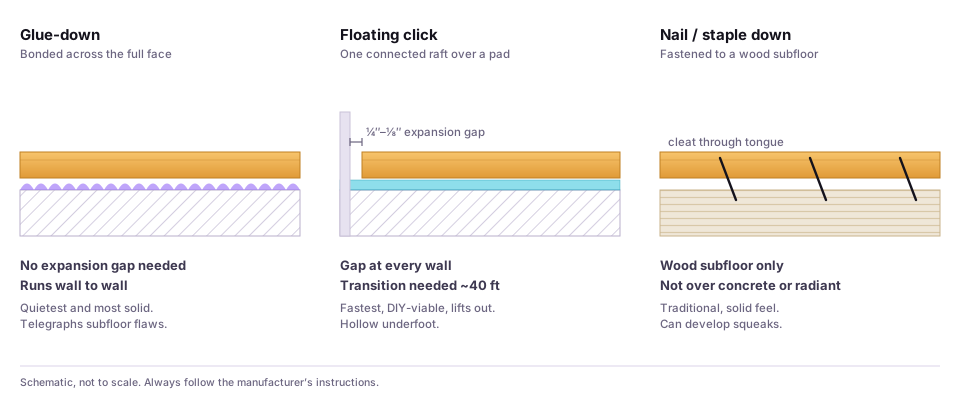
The subfloor eliminates an option, then you still have a choice
Concrete rules out nailing — there is nothing to drive a fastener into, short of building a plywood subfloor on top, which adds height and cost. Over plywood or OSB above grade, all three are available and nail-down is the traditional route. But establishing the subfloor only narrows the field; over a slab you still have to pick between glue-down and floating, and that choice comes down to three things: how wet the slab tests, how wide the planks are, and whether you can live with hollow sound. Wet slab or DIY install, float it. Wide planks, radiant heat, or a floor you want to feel solid, glue it.
Plank width pushes you toward glue-down
Wide planks want to cup and move more than narrow ones, simply because there is more width across which humidity can act. Full-spread adhesive holds the whole board down across its entire face and resists that movement in a way point fasteners and a floating installation cannot. At 7 inches and wider, most manufacturers either recommend or require glue-down, and some warranties depend on it. Read the instructions on wide-plank goods before you commit to a method.
Nail-down is off the table over radiant heat
You cannot drive fasteners into a subfloor with hydronic tubing or electric mats in it, and the risk of finding one is not worth taking. That leaves glue-down and floating. Glue-down is generally preferred over radiant because full contact conducts heat efficiently, whereas a floating floor over a pad puts an insulating layer between the heat and the room. Whichever you choose, respect the surface temperature limit — typically around 80 to 85°F — and bring the system up gradually.
Sound and feel separate the three clearly
Glue-down is bonded across its whole face with no air gap, so it is the most solid and the quietest — closest to a nailed solid floor in feel. Nail-down is also solid, though fastener spacing can produce occasional squeaks over time. Floating sits on a pad and drums underfoot; good underlayment helps but does not eliminate it. In a large open room the difference is obvious the moment you walk across it.
Moisture tolerance runs the other way
Adhesive is the component that fails when a slab pushes vapor. Test to ASTM F2170 before any glue-down goes over concrete — the general limit is 75% relative humidity unless the manufacturer allows more, and moisture-control adhesives extend that considerably. Floating over a vapor retarder is the more forgiving option precisely because nothing is bonded to the slab. On a basement floor or a slab that has taken water before, that difference is worth real money.
Flatness matters for all three, in different ways
Glue-down conforms to the substrate, so dips and ridges telegraph through where raking light will find them. Floating spans small irregularities visually, but the plank then flexes over the void and that repeated deflection opens the joints. Nail-down over an uneven subfloor produces squeaks and movement at the fasteners. Around 3/16 inch over 10 feet is the common target for plank goods, tightened where appearance is critical. Preparation is not the place to save money on any of the three.
Repairs and removal differ sharply
A floating floor comes apart from the nearest wall, so a damaged plank in the middle of a room is reachable, and the whole floor can be lifted and reused. Glue-down means heating and prying the plank, scraping adhesive and setting a replacement — contained, but messy. Nail-down sits between the two. Removal at end of life is where the gap is widest: floating lifts out in an afternoon, glue-down is a demolition job that frequently damages the slab surface.
A floating floor moves as one raft; a glued floor does not
This is the difference that generates the most callbacks, and it matters more with wood than with vinyl because wood responds to humidity. A floating floor is one connected field that expands and contracts as a unit, so it needs a 1/4 to 3/8 inch gap at every wall, at every door jamb, and around every pipe and cabinet toe kick — and manufacturers cap how far it can run before it needs a break, commonly somewhere around 40 feet in a direction, at which point a T-molding splits it into independent sections. Glue-down has none of these constraints. Every board is anchored on its own, so the floor runs wall to wall through the whole house with no transition strips breaking up the sightlines. In an open plan, that is often the entire argument.
Seasonal gapping shows up in different places
Wood shrinks in the dry season whichever way it is installed — where the movement goes is what changes. A glued floor holds each board in position, so shrinkage distributes as many small gaps between boards, spread across the room and largely unnoticed. A floating floor moves as a field, so the same total movement collects at the perimeter or wherever the raft is restrained, which can read as one obvious gap along a wall or a separation at a doorway. Neither is a defect. But if seasonal gapping is going to bother you, glue-down distributes it far more gracefully, and keeping indoor humidity in the 35 to 55 percent range matters more than the method either way.
Cost tracks labor, not material
The flooring costs the same whichever way it goes down. Glue-down adds adhesive, trowel work and cure time before furniture returns, and it demands the flattest substrate, so preparation rises too — it is normally the most expensive of the three installed. Nail-down is quicker than glue but needs a wood subfloor. Floating is the cheapest and fastest, which is exactly why retail pushes it. If two bids differ sharply, check which method each assumed before comparing the numbers.